Your Child’s Brain Map
Tap the glowing brain to see how stories, sounds and pictures help young brains grow — and pick up one small thing to try tonight.
This week
What’s been happening over the last 7 days.
See your child’s map light up
Sign in and this page shows the stories, quizzes and phonics games your child has done this week — and lights up the parts of the brain they’ve been exercising.
Explore the brain
Tap a spot to see what it does, why stories help, and one thing to try tonight.
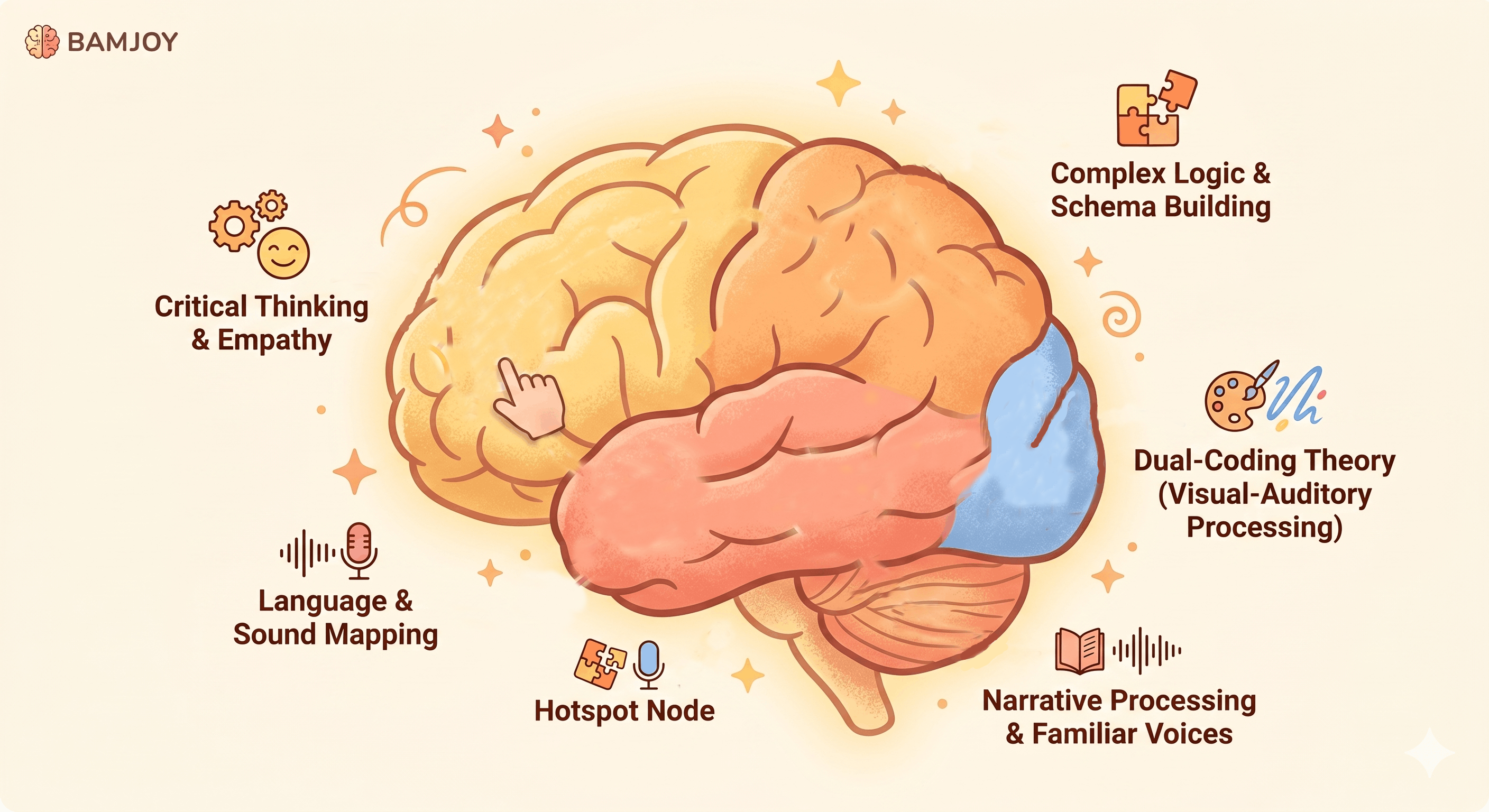
Pick a spot on the brain
Each glowing spot is an area that stories, pictures and phonics help to exercise. Tap one to find out more.
Explore it together — children love finding the “sounds” part and the “stories” part.
The science behind BAMJOY
Six short, plain-English guides to how stories help children learn.
Neuroplasticity & Narrative Threads
Every story your child hears helps build the brain's language and memory pathways. Repetition through personalised narratives strengthens these connections.
Read more →The Power of Familiar Voices
A familiar, loving voice helps a child feel safe and engaged at story time — and BAMJOY's planned Parent Voice Legacy feature is built on this idea.
Read more →Dual-Coding Theory
Pairing words with pictures helps a child understand and remember more than words alone — and far more than passively watching a screen.
Read more →Language & Sound Mapping
Connecting letters to the sounds they make builds the pathways behind confident reading — and BAMJOY's phonics aligns to the DfE Letters & Sounds phases.
Read more →Critical Thinking & Empathy
Stories let children step safely inside someone else's shoes, building empathy and the beginnings of moral reasoning.
Read more →Complex Logic & Schema Building
Following a story's shape — beginning, problem, resolution — helps children build mental frameworks they later use to reason and solve problems.
Read more →Tonight at home
Four small habits and a reading timer. Ticks reset each day and stay on this device only.
Tonight’s story question
Ask this during or after tonight’s story. The five types come from dialogic reading (known as CROWD).
Where would you most like to go from the story, and why?
Who, what, where, when, why questions.